
Is Your AI Production Company Ready for the EU AI Act? Why Delirio AI signed the EU Code of Practice on Transparency of AI-Generated Content
Delirio AI has signed the European Union’s Code of Practice on Transparency of AI-Generated Content. For the agencies, production companies and brands we work with, the question behind it is practical: when AI is part of the production, who makes sure the work is ethical, compliant and transparent? Our answer: your AI production company, from the brief to the final file.

EU Code of Practice in one minute
Since 2 August 2026, Article 50 of the EU AI Act requires transparency for AI-generated and AI-manipulated content. AI tool providers must mark what their systems produce in a machine-readable way. The companies that publish realistic synthetic content (deepfakes) must tell their audience that it was made or altered with AI.
The Code of Practice on Transparency of AI-Generated Content turns those duties into concrete measures. It was drafted by independent experts with the European Commission’s AI Office and input from more than 180 organisations, including AI developers, broadcasters, film and advertising associations and civil society. The final code was published in June 2026, and the Commission has assessed it as an adequate way to demonstrate compliance with Article 50.
- Section 1 is for the companies that build generative AI tools: marking their outputs with metadata and watermarks, and offering detection.
- Section 2 is for the companies that use those tools to make and publish content: labelling deepfakes clearly, documenting decisions and training their teams. This is the section Delirio AI has signed.
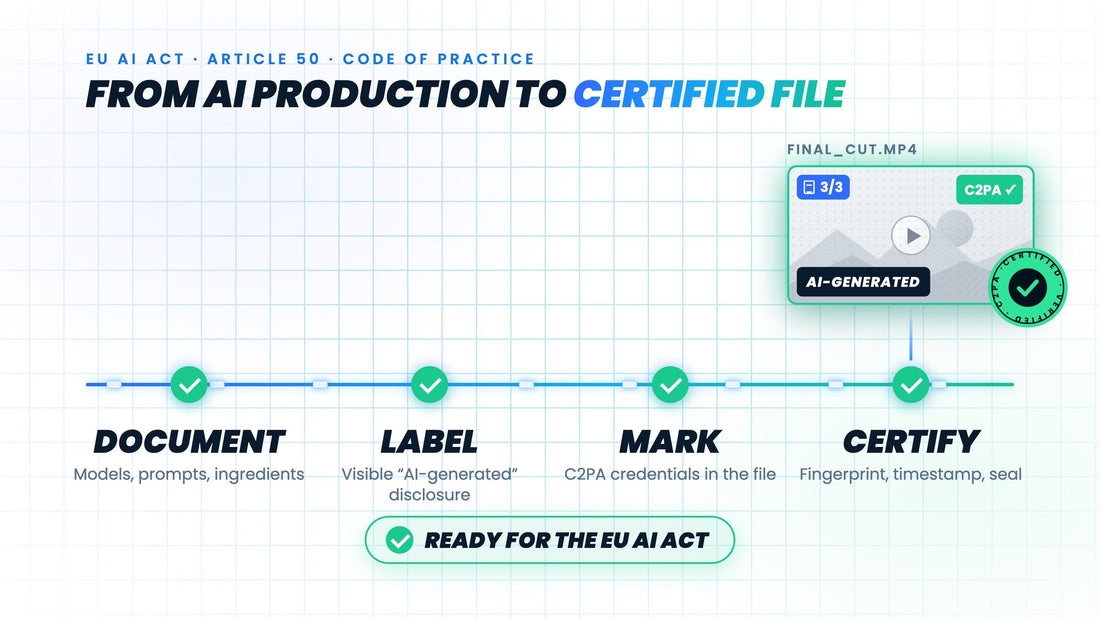
How an AI production becomes a certified file: a documented process, a visible label, C2PA Content Credentials inside the file and a certificate with a fingerprint and a timestamp.
What changes for agencies and production companies
Under the Commission’s guidelines on Article 50, the company that uses AI under its own authority is the “deployer”, and the transparency duty sits with it. In advertising and film, that is usually the agency or production company that makes the creative decisions, including the freelancers working under its responsibility. A brand that simply commissions the work, without controlling how AI is used, is generally not the deployer.
In other words, responsibility follows the production. The labelling duties for deployers already apply; the extra time granted by the EU’s “digital omnibus” only covers the tool providers’ technical marking. Breaches of Article 50 can lead to fines of up to €15 million or 3% of worldwide turnover. Beyond the fines, a synthetic face or place that is not disclosed can cost a campaign its credibility in a single news cycle.
Creativity is not the problem
The code does not ask you to stamp a warning on every frame. The obligation targets content that could mislead people into thinking it is real. The Commission’s own examples help:
- Usually not a deepfake: talking animals in a food commercial, real actors in front of AI-generated backgrounds, a real product placed in an AI setting that does not mislead, or routine edits such as colour correction and relighting.
- A deepfake that needs a clear label: a realistic synthetic person presented as real, such as an AI-generated celebrity or spokesperson, or a product shown in a way that misleads.
- Somewhere in between: work that is evidently artistic, creative, satirical or fictional can use a lighter disclosure, for example in the credits or description. Advertising is assessed case by case, and synthetic people demonstrating a real product do not count as “evidently creative”.
Getting this right is a creative and strategic decision, not a box to tick at delivery. That is why it belongs in the hands of the team making the work.
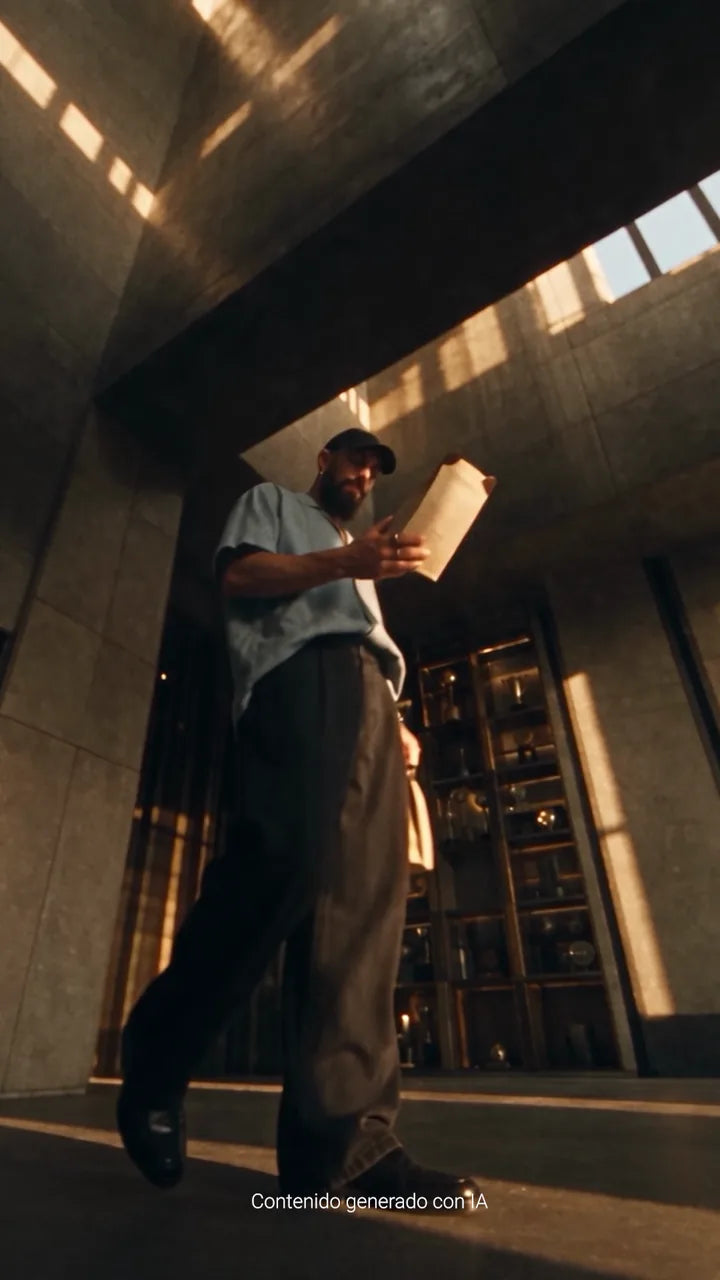


Real talent, real consent, a clear label. In our spot for Wallapop with footballer Borja Iglesias (creative agency: This is Odd), every shot carries the on-screen label “Contenido generado con IA” (AI-generated content).
Why your AI production company matters
Most agencies and production companies do not want to become AI compliance experts. They want to make great work that clients can publish without worry. An AI production company that is involved in the whole process, and leads on ethics and transparency, takes that weight off the project:
- Transparency decided at the brief, not at the end. Whether a shot needs a label, the lighter creative disclosure or nothing at all is planned with the creative idea, so the label never feels bolted on.
- Proof, not promises. Every asset should come with a record of how it was made: tools, references and the human creative decisions behind it. When a client, a platform or a journalist asks, the answer is already on file.
- Provenance that survives post-production. AI tools now embed metadata and watermarks in their outputs, and the code expects them to stay there. A careless pipeline can strip them in the grade or the export.
- One standard for the whole team. Directors, artists and freelancers all follow the same rules, from the first test to the last version.
- Ethics beyond the minimum. Consent for real people’s likeness and voice, no imitation of real brands or people without permission, and honest framing when AI recreates real events.
- Your client’s data stays your client’s. Unreleased campaigns, product shots and talent images are confidential. The tools in the pipeline should be chosen for where they are based, how they handle data and whether they train their models on what you upload.
- Every market and platform covered. One idea becomes dozens of versions and formats, and YouTube, Meta and TikTok each have their own AI-labelling rules on top of the EU’s. The company producing the versions should handle the labels too.
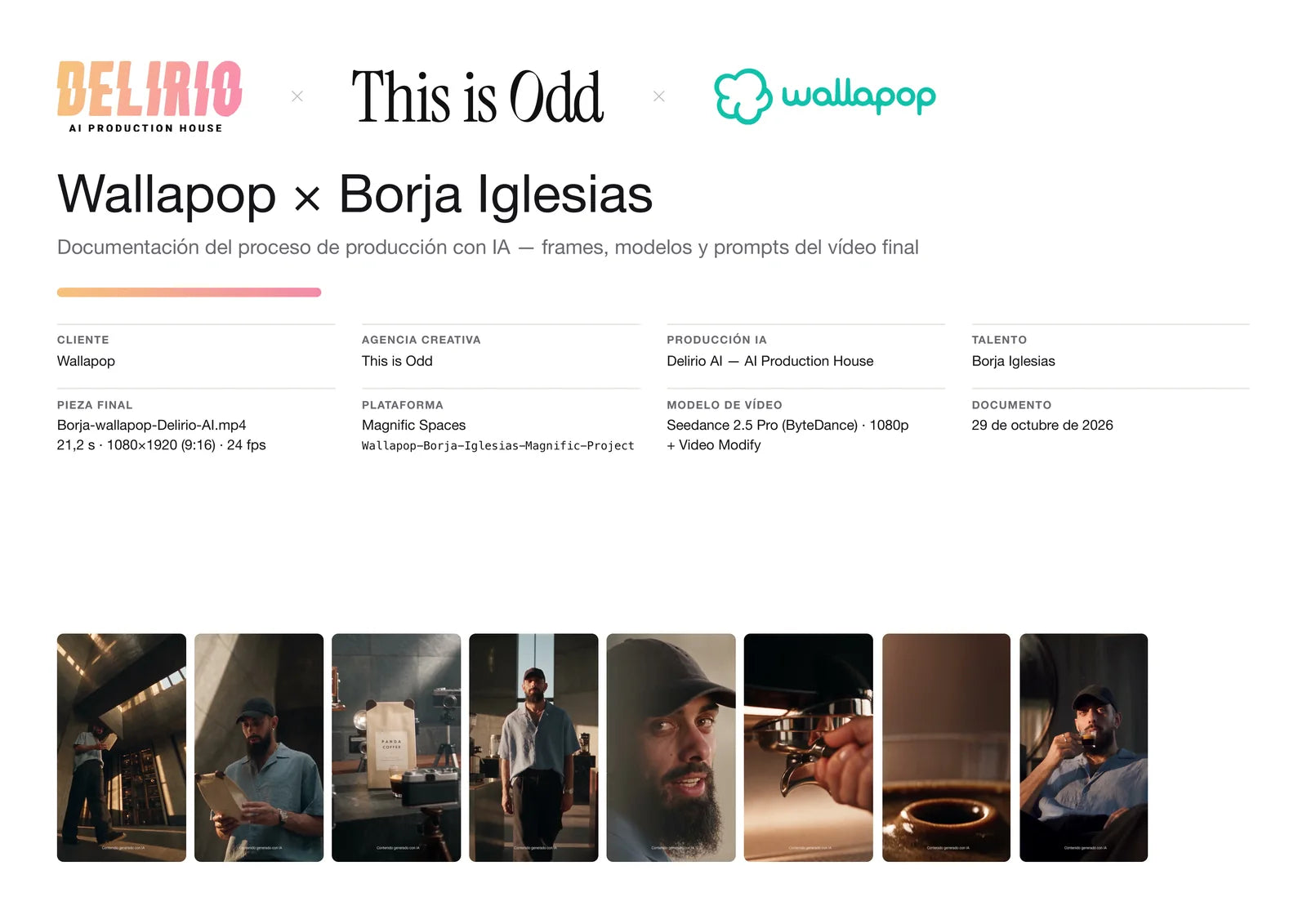
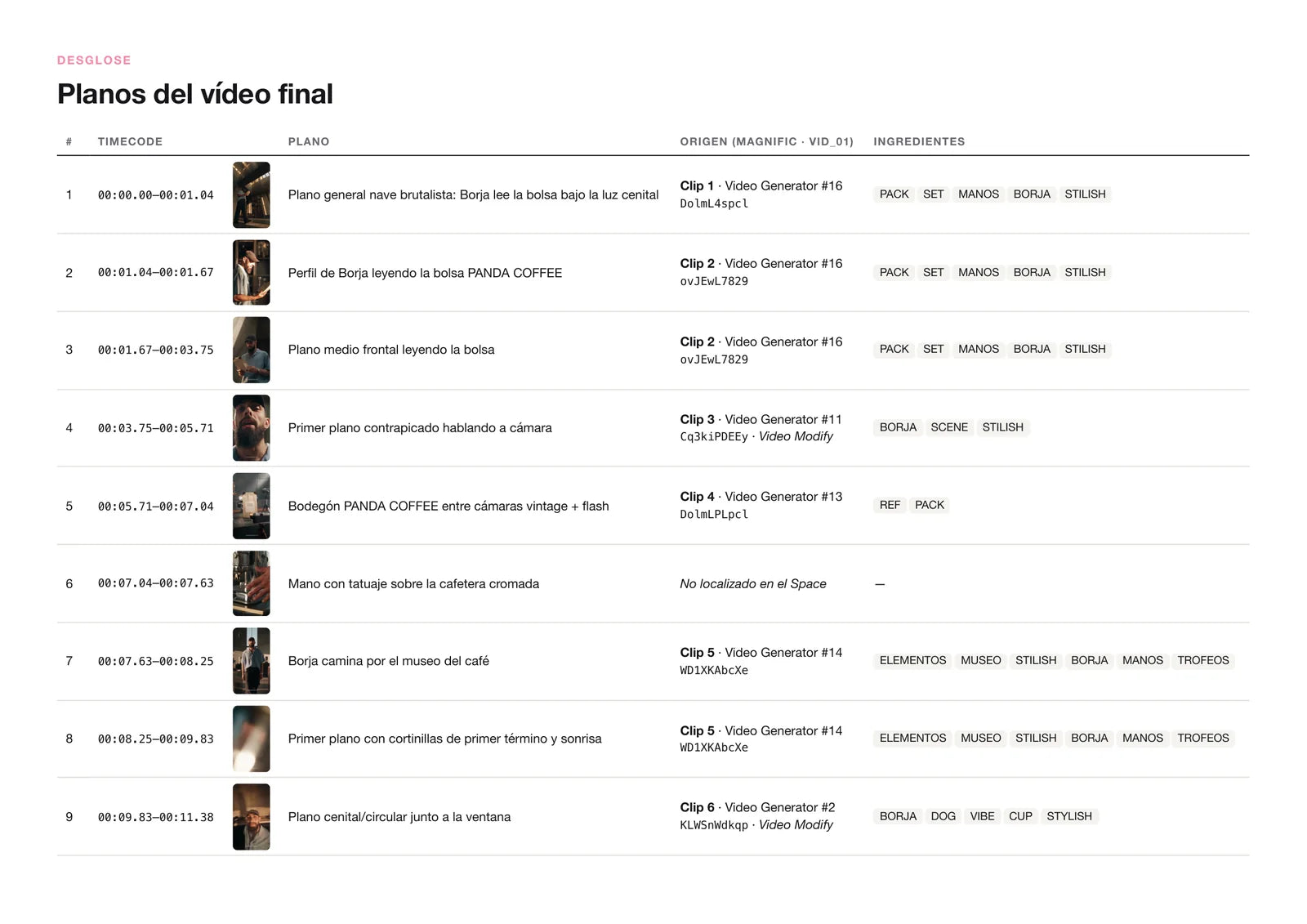
Proof, not promises: the production record of the Wallapop spot documents the whole process, from brainstorming to the final cut, and every shot with the models, prompts and reference images (the “ingredients”) behind it.
Questions to ask before you commission AI video or images
- Have you signed the EU Code of Practice on Transparency of AI-Generated Content?
- Who decides whether each asset needs a label, and when in the process?
- Can you show how each asset was made, and in what form?
- Do your deliveries carry verifiable content credentials, such as C2PA?
- Will the AI markings survive editing, grading and export?
- How do you handle real people’s likeness, voices and brands?
- Which AI tools do you use, where are they based, and do they train their models on our material?
- Are your directors, artists and freelancers trained on these rules?
- How do you adapt labelling to each market and each platform?
If your current supplier hesitates on these answers, that is useful information.
Who else has signed the code?
As of November 2026, the official list of signatories includes 103 organisations under Section 1 and 218 under Section 2.
- Section 1, AI tool providers: Anthropic, Google, Meta, Microsoft, Mistral, OpenAI, Black Forest Labs, Cohere, Aleph Alpha and Synthesia, among others.
- Section 2, companies that create and publish content, alongside Delirio AI: advertising and media groups such as Dentsu, several McCann offices and Universal Media, Getty Images, and companies such as Lufthansa, Lenovo, Iberdrola, Bulgari and Fastweb, together with public bodies, publishers and creative studios across Europe.
Also on the list, in both sections, is VeriqX, our certification partner. When the tools, the producers and the advertising networks sign the same code, transparency stops being a competitive risk and becomes the industry standard.
How we work with agencies and production companies
Delirio AI is the AI production company behind agencies, production companies and brands: full AI production, smart AI-powered VFX and tailored B-roll shots created for each project. Signing the code puts in writing how we already work:
- Labelling to the highest standard. In every brief we propose how each piece should be labelled, to the highest standards of EU law and applicable US laws, using C2PA, the open standard for content provenance.
- Every delivery documented and certified. All our deliveries are documented and certified through VeriqX, our certification partner, with C2PA Content Credentials and a timestamp, so you and your client can verify every file.
- Provenance from the first ingredient. In the final export we keep the metadata of the whole process, the “ingredients” of each piece, and add the final certified metadata through VeriqX.
- One compliant process for everyone. Our directors, artists and freelance collaborators follow the same process and our ethical-AI rules. For example, using copyrighted images or the names of real people or brands in our AI work is strictly prohibited.
- Real people, only with their consent. We never recreate real people, voices or brands without permission. When a campaign features real talent, it is with their participation and consent: for Wallapop, for example, we worked with footballer Borja Iglesias, 2026 World Cup champion with Spain.
- European tools that respect your data. For image and video generation we work with Magnific, the AI creative platform based in Málaga, Spain (formerly Freepik). In its AI Products Terms and Conditions, Magnific commits not to use your inputs or outputs to train its own AI models and states that its AI products are designed in line with the EU AI Act. On its Enterprise plan it goes further: your inputs and outputs are not used to train or fine-tune any AI model. It also complies with the GDPR and the EU Digital Services Act (see its Terms of Use). For brands, that means unreleased material stays confidential.
- Support for your own team. If your agency wants to produce AI content in-house, our AI production consulting helps you set up the same practices. Our FAQ and disclosure page explains usage rights and copyright.
The final Wallapop spot with Borja Iglesias (9:16, 21 seconds). The AI label stays on screen in every shot.
Sources
- European Commission: Code of Practice on Transparency of AI-generated Content
- European Commission: Signatories of the code
- European Commission: Guidelines on the transparency obligations of Article 50
- VeriqX: What the EU AI Act means for AI content production
- Magnific: AI Products Terms and Conditions and Enterprise content and legal
Further reading
More from Conversations on AI Filmmaking, our blog about the craft of AI filmmaking.

The Auteur & The Machine
Hollywood met generative AI with outrage. Now auteurs like Darren Aronofsky, Danny Boyle and Natasha Lyonne are testing it as a creative tool. Matias Basso looks...
Read the article
The Role of the Actor in the Age of AI
Realistic AI performances no longer need actors. Matias Basso looks back at how cinema disrupted theatre and argues that AI will not end acting, but remind...
Read the article
Cinema is a Lie
Soon someone will make a photorealistic feature film entirely with AI. Filmmaker Matias Basso asks how we will feel about it, and why a strong story...
Read the articleTransparent by design, from brief to final file
Planning a full AI production, smart AI-powered VFX or tailored B-roll shots? Tell us about it and we will show you how we label, document and certify every piece.